Holding a Pre-Employment Public Lecture, FEB ULM Presents Deputy III of the Presidential Staff Office
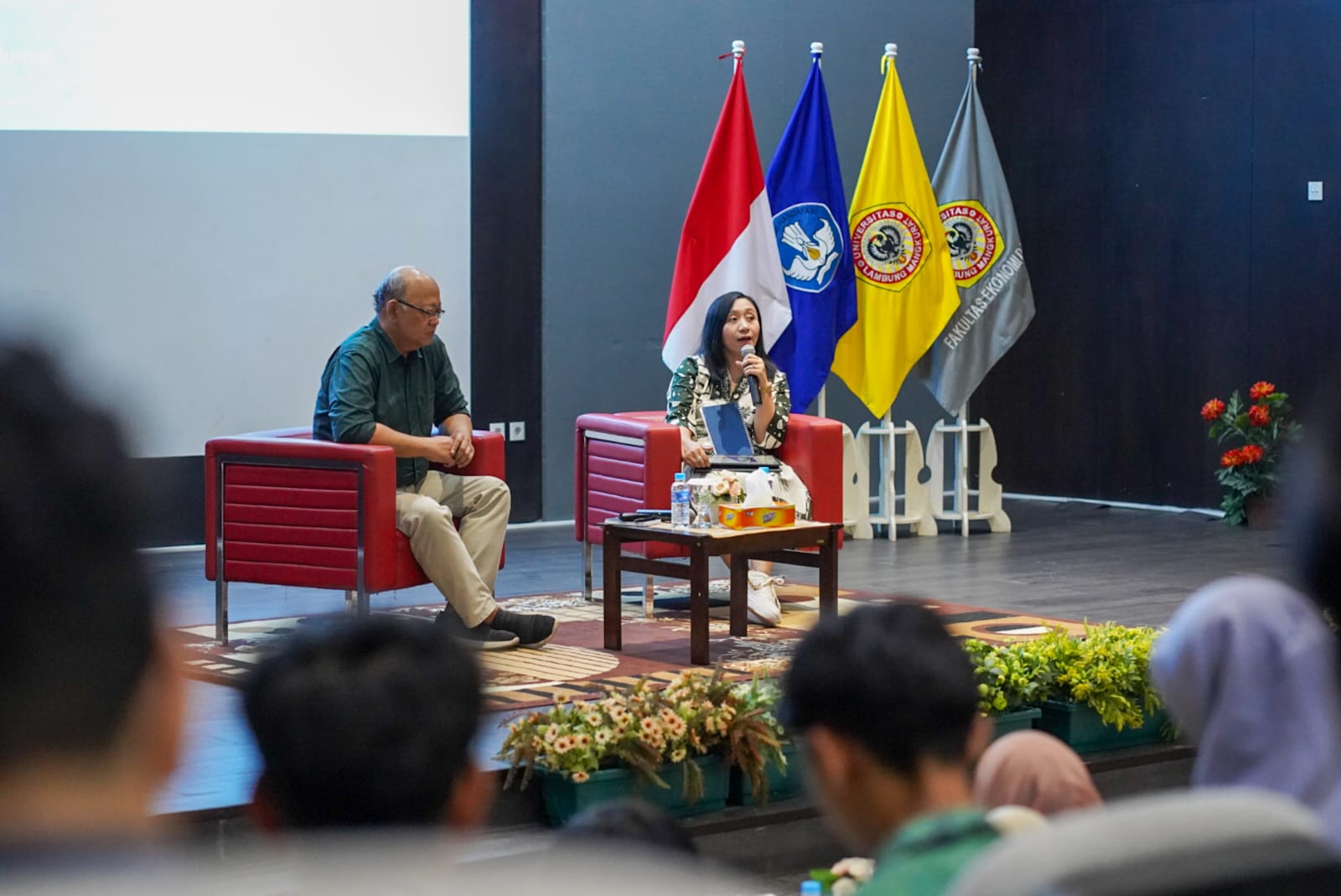
Banjarmasin – The Faculty of Economics and Business (FEB) Lambung Mangkurat University (ULM) held a public lecture with the theme Pre-Employment: Employment and Public Service Innovation on Friday (1/9/2023) at the Lecture Theater FEB ULM Banjarmasin. In this event, FEB presented Deputy III of the Presidential Staff Office, Dr. Ir. Edy Priyono, M.E., as resource person.
Vice Dean for Academic Affairs FEB ULM, Ahmad Rifani, MM., in his speech said that this public lecture was held as an effort to introduce and provide understanding about the Pre-Employment program. “There are still many who don’t know or there are those who have heard about it but don’t really understand what the Pre-Employment program is like. “Listen, take notes and prepare questions you want to ask regarding pre-employment,” he said.
Through this event, the Vice Dean also hopes that this kind of activity can continue and be held in the form of other programs that provide benefits to students. Apart from that, this event is also a manifestation of the implementation of the Independent Learning-Free Campus program.
The Pre-Employment Program is a work and entrepreneurship competency development program aimed at job seekers, workers/laborers who have been laid off, and/or workers/laborers who need increased competence, including micro and small business actors. The Pre-Employment Program itself was launched in April 2020.
In the material provided, Dr. Edy said that there are 8 aspects of decent work based on the International Labor Organization (ILO). Among them are:
1) Job opportunities; 2) Income; 3) Working hours; 4) Jobs that must be eliminated; 5) Stability and job security; 6) Equality; 7) Social security; and 8) Representativeness.
The following is Dr. Edy regarding working conditions in Indonesia based on ILO standards:
- Employment Opportunity. The Open Unemployment Rate (TPT) in Indonesia will decrease in 2022 from 2021, namely from 6.49% to 5.86%. The highest TPT for vocational and high school graduates, so that in the short term it is necessary to create jobs for vocational school graduates. The majority (around 60%) of workers in Indonesia are informal workers.
- The average worker in Indonesia receives low wages (below 2/3 of the median wage). However, average wages are rising. This indicates that there is a growing income gap.
- Working hours. More and more workers are working excessive hours.
- Jobs to be deleted. Namely child labor. The number of child laborers is still quite large, but the percentage has decreased slightly.
- Stability and job security (job tenure). The average person has worked for 12 years in their current job. The higher the education, the shorter the job tenure, coupled with the fact that the majority of workers in Indonesia are informal workers, the length of job tenure is actually a negative indication.
- The majority of men work in the production sector, while the majority of women work as sales personnel. Meanwhile, the proportion of women in managerial positions is low and decreasing. There is also a wage gap between male and female workers. This gap is even likely to increase. Meanwhile, the proportion of workers with disabilities is increasing, indicating that the labor market in Indonesia is becoming more inclusive.
- Social Security. Social security coverage remains low, especially for casual workers.
- Membership in trade unions remains low.
From this description, Dr. Edy said that it can be concluded that practically from a job perspective in Indonesia there are no serious problems, but there are problems with the quality of work.
Therefore, the government issued policies based on 2 points of view. From a demand side perspective, the government encourages the creation of new formal jobs, including through the Job Creation Law. Meanwhile, from a supply side perspective, the government has issued a policy to improve the quality of the workforce through better education and training, including through the Pre-Employment Card program.