SME Mentoring by ULM: From Patin Fish to High-Value Products
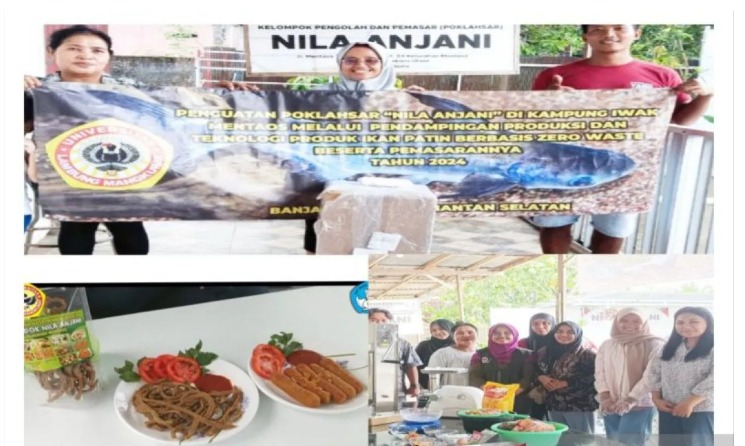
Banjarbaru – A team from Lambung Mangkurat University (ULM), consisting of the Faculty of Mathematics and Natural Sciences, the Faculty of Fisheries and Marine Sciences, and the Faculty of Agriculture, has provided training on waste-free patin fish processing to the Nila Anjani Fisheries Product Processing and Marketing Group (Poklahsar) in Banjarbaru. “We introduce various processed patin fish, including the bones which are processed into sausages and sticks, so as to achieve zero waste,” said Sasi Gendro Sari, a lecturer in the Biology Study Program, FMIPA who led the ULM team in Banjarbaru, on Monday.
In front of dozens of Small and Medium Enterprises (SMEs) in Poklahsar Nila Anjani, Iwak Mentaos Village, Banjarbaru, South Kalimantan, the ULM team directly practiced making patin fish sausages and fish bone sticks from patin fish waste. This process starts from preparing fresh catfish to processing it into sausages, and the remaining or bone waste is then reprocessed into fish bone sticks.
“So, there really is no waste from this catfish processing product. All parts, from the bones, head, tail, to the fins, are used as raw materials for fish bone stick products,” explained Sasi. In addition to teaching how to make the product, the ULM team also provides assistance in marketing, especially promotion in the online market by utilizing digital technology.
Sasi is optimistic that sausage products from catfish and fish bone sticks have promising business prospects, considering that this product is still rarely sold on the market, which has so far been dominated by processed beef and chicken. The advantage of this product lies in the premium raw materials that are rich in antioxidants, vitamin A, and Omega, and without preservatives, so it is safe and healthy to consume within the expiration date.
Diversification of processed catfish food products based on zero waste and marketing assistance was carried out by three inventors, namely Sasi Gendro Sari, Candra, and Lya Agustina, with financial support from the Directorate of Research, Technology, and Community Service, Directorate General of Higher Education, Research, and Technology, Ministry of Education, Culture, Research, and Technology, based on Contract Number 1079/UN8.2/AM/2024.